Swag Hooks
An album of new songs built on records from 1909 to 1924.
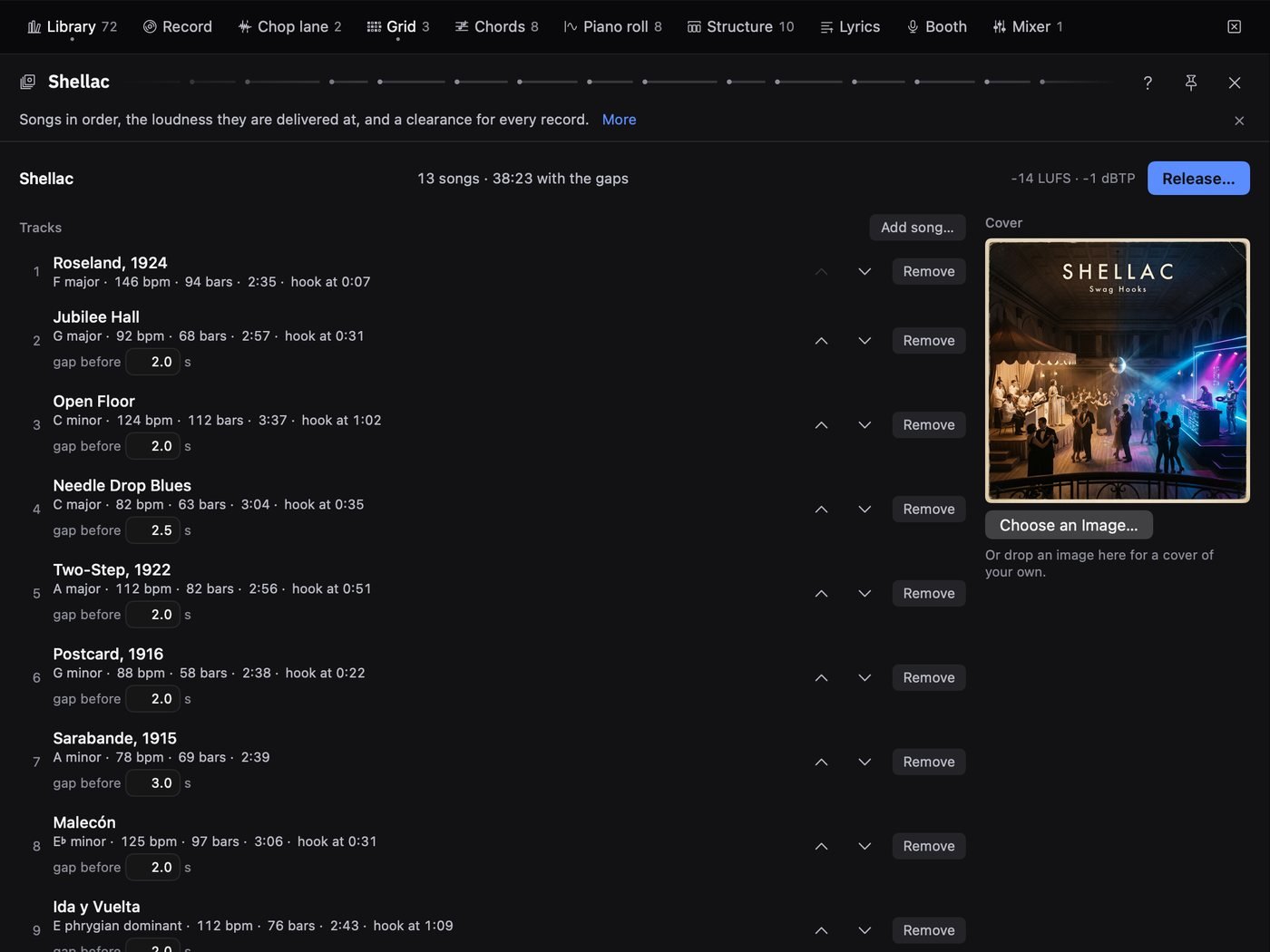
Swag Hooks makes new songs around a few bars of very old records. The first album, Shellac, has thirteen songs, each built on 78s from 1909 to 1924 that are now in the public domain: Bessie Smith, Fletcher Henderson’s orchestra, Pablo Casals, the Fisk University Jubilee Singers, and more. The singers on those records are the album’s voices.
Every other note was written in Mr. Roboto and played on its sounds, and every level was set on its mixer. Swag Hooks asked for the songs and judged them by ear; Claude wrote the parts using the same actions the app’s band uses.
The songs run from swing and gospel to house, klezmer, trap, and a film cue. Shellac hasn’t been released; six of its songs are below.
- Status
- Complete
- Built with
- Mr. Roboto
- Claude
- Library of Congress National Jukebox
- Where to find it
- Listen to six songs
- Notes
- Shellac: 13 songs, 39 minutes
- Built on 23 public-domain recordings
- Mastered to −14 LUFS for streaming
- Not released
Listen
Six of the thirteen songs on Shellac. Each one says which old records it’s built on; everything else was made in Mr. Roboto.
Roseland, 1924
A dance-hall blues for a big band: a riff for the horns, a chorus each for trumpet, clarinet, and piano, then the shout chorus to finish.
Built on: Four bars of Fletcher Henderson’s orchestra, 1924, which open the song and break it up
Two-Step, 1922
A country two-step: an electric guitar through a crunchy amp on the boom-chick rhythm, an upright piano, and a harmonica on the tune.
Built on: Frank Ferera’s steel guitar, 1916, at the start and under the second verse; Eck Robertson’s fiddle, 1922, taking every chorus
Postcard, 1916
An old steel guitar loops slowly under a dusty drum kit, a piano, and an upright bass, then gets chopped onto pads and played back in a new order. A marimba band, a choir’s held note, and a cello drift through.
Built on: Frank Ferera’s steel guitar, 1916; the Marimba Azul y Blanco, 1920; a choir; two bars of Pablo Casals playing Bach, 1915
Sarabande, 1915
A film cue in three. Strings take up a theme of their own over a harp and a bowed bass; timpani, oboe, and bassoon build it up; a French horn and tubular bells reach the top. The cello closes it, in a cathedral-sized space.
Built on: Pablo Casals playing the Sarabande from Bach’s third cello suite, 1915, alone at the start and again at the end
Malecón
Four bars for flute, piano, bass, and congas, grown into a whole song by Mr. Roboto’s Develop tool. The band follows the old orchestra’s chords, and the orchestra’s own last bars end it.
Built on: A Havana dance orchestra, 1915
Bulgar, 1923
A clarinet plays a tune of its own over accordion and upright piano on the oom-pah, with a brass-band tuba, a fiddle, and a trumpet.
Built on: Naftule Brandwein’s orchestra, 1923, alone at the start and then under the band; Harry Kandel’s band, 1921, in the minor section
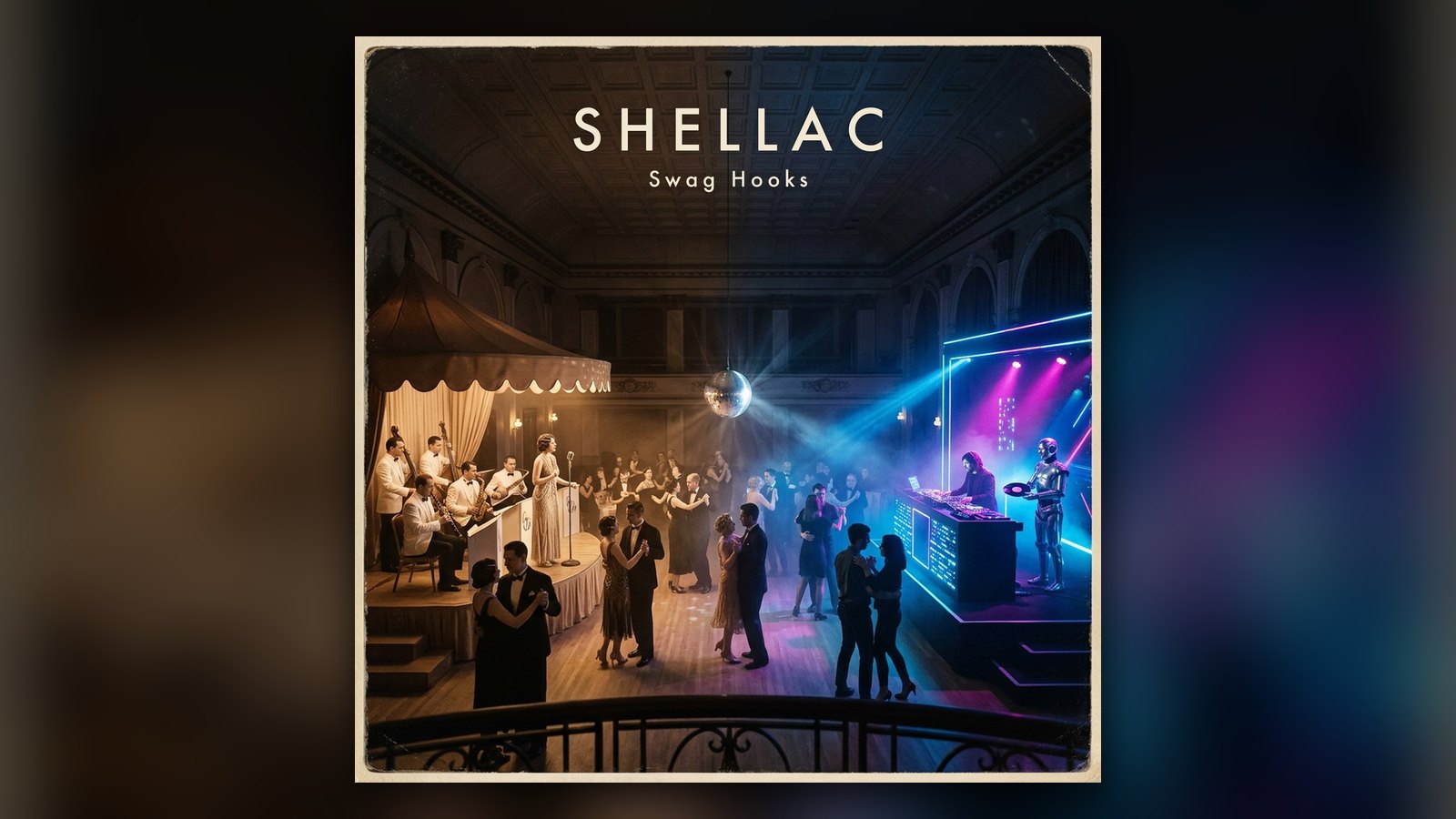
The old records are in the public domain in the United States and come from the Library of Congress National Jukebox. The band plays the Salamander Grand Piano (CC BY 3.0, Alexander Holm), VSCO 2 Community Edition, the Versilian Community Sample Library, Karoryfer Samples, the MTG solo saxophones, the Splendid, Headroom and Osiris pianos, Greg Sullivan’s electric pianos, Jeff Learman’s steel drum, FreePats’ guitar and accordion, the Sonatina Symphonic Orchestra’s chorus, Orange Tree Samples’ timbales, Seidhepriest’s cuíca and body_percussion’s palmas, under their own licenses (CC0, CC BY, CC BY-NC 4.0, CC Sampling Plus 1.0, freeware, and public domain). The cover was made with an image model.